
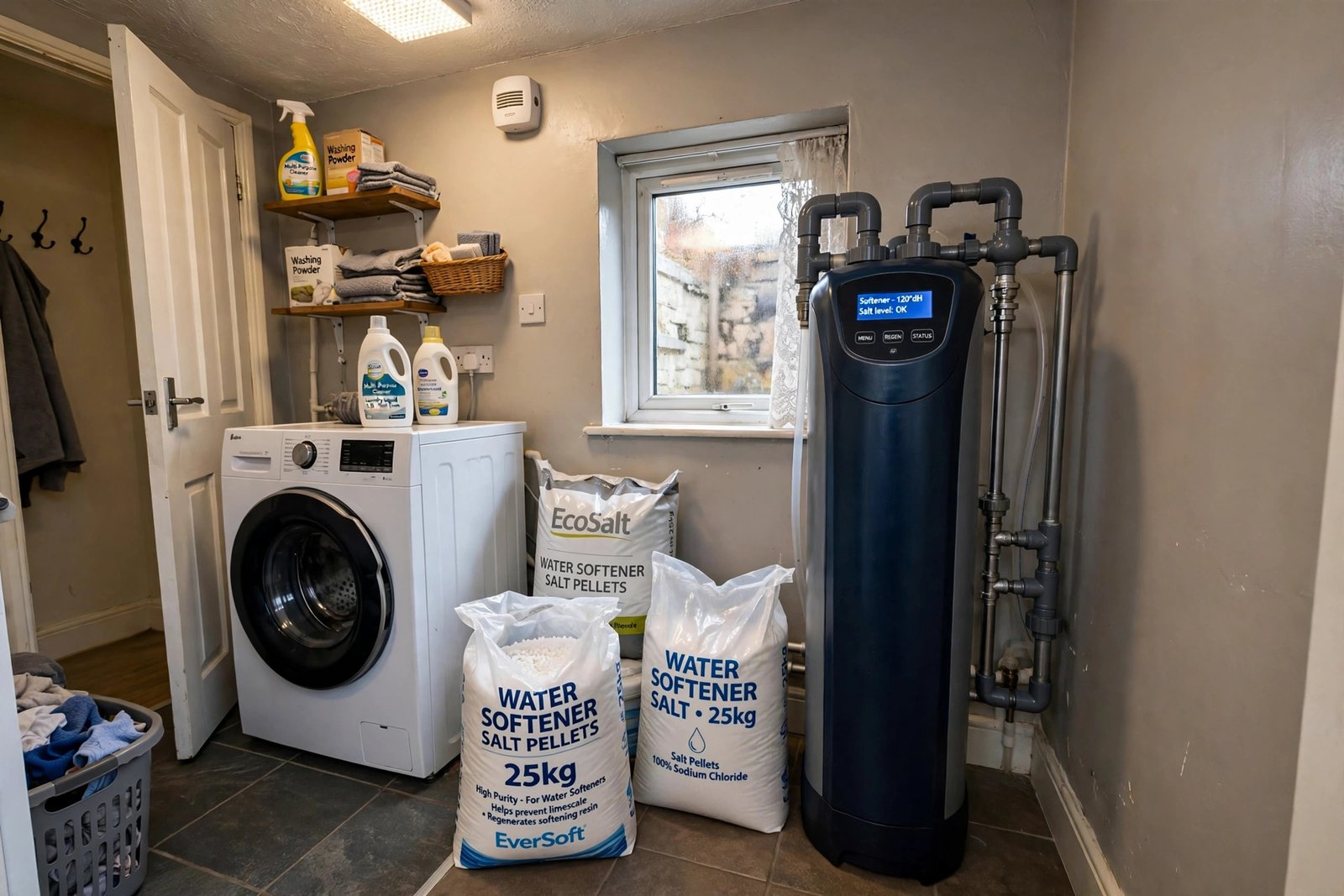
Quick answer: For a family of four, a water softener costs roughly £60 to £180 a year to run in the UK, and salt makes up most of it. Expect about 150kg of salt a year, a few pounds of electricity, and a small amount of extra metered water. Non-electric models use no electricity, and salt-free conditioners use no salt.
The unit itself is the expensive part. Once it is fitted, the running cost is small, but nobody gives you one clear figure, because the guides disagree with each other. One says £50 to £100 a year, another says £50 to £150, and a third says £30 to £190 depending on the model. All three can be right, because the answer depends on how many people live in the house, how hard the water is, and which type of softener you own. This guide works it out in pounds, by household size, so you can see your own number instead of guessing from a headline. If you are still choosing a unit, our guide to how much is a water softener covers the buying and installation prices. This article is only about what it costs to keep one running.
How Much Does a Water Softener Cost to Run in the UK?
For a family of four, expect roughly £60 to £180 a year all in. That range comes from the sources themselves: one UK buying guide puts the combined salt, water and electricity cost at £60 to £180 a year, another puts salt alone at £50 to £100 a year, and a dedicated running-cost guide puts the total at £50 to £150 a year. The spread is wide because the guides are describing different households, different water hardness and different salt types. The table below narrows it down to your household, using the figures the sources agree on.
| Household size | Salt per year | 25kg bags per year | Salt cost per year | Electricity per year | Extra metered water per year | Total per year | Total per month |
|---|---|---|---|---|---|---|---|
| 1 person | About 50kg | 2 | £20 | £5 to £10 | About £5 | £30 to £35 | About £3 |
| 2 people | About 100kg | 4 | £40 | £5 to £10 | About £10 | £55 to £60 | About £5 |
| 4 people | About 150kg | 6 | £60 | £5 to £10 | About £15 | £80 to £85 | About £7 |
| 6 people | About 200kg | 8 | £80 | £5 to £10 | About £20 | £105 to £110 | About £9 |
The worked figures use generic tablet salt at £10 per 25kg bag, which is the middle of the £8 to £12 range charged by B&Q and Screwfix. At £8 a bag, the four-person salt cost is £48 a year; at £12 a bag it is £72. The salt quantities come from a UK running-cost guide: about 100kg a year for two people, 150kg for four and 200kg for six, with a four-person home in a hard-water area using 150kg to 200kg. The totals are for an electric, metered softener. A non-electric model uses no electricity, so take £5 to £10 a year off these totals. A home without a water meter pays nothing extra for the regeneration water, so take that line off too.
One supplier gives a simpler rule of thumb: about £2.50 to £3.00 per person per month. That works out at £30 to £36 a year per person, which is above the worked figures in the table for larger households. The difference is the salt: the per-person rule reflects delivered block salt, while the table uses generic tablet salt bought in 25kg bags, which costs less per kilo. Both are honest figures for different ways of buying salt, and the gap between them is the first saving worth knowing about.
The running cost also buys something back. Limescale acts as insulation on heating elements and boiler surfaces, and the Carbon Trust has found that around 1mm of scale can increase the energy needed to heat water by about 7%, while British Water estimates roughly a 12% efficiency loss at around 1.6mm of scale. Soft water also lathers with far less soap, shampoo and washing powder, and you stop buying descaler for the kettle and shower head. Those savings vary a lot by household, but in a genuinely hard-water area they often cover the cost of salt several times over. If you are already fighting limescale, our guide on how to clean limescale from a toilet shows what the build-up looks like when it is left alone.
What Does the Salt Actually Cost Each Year?
Salt is where most of the money goes. A softener works by passing mains water through resin beads that swap hardness minerals, calcium and magnesium, for sodium. When the resin is full, the unit cleans itself by flushing brine through it, a process called regeneration, and that is what uses the salt. The salt itself is ordinary sodium chloride, sold as tablets, granules or blocks, and all three do the same chemical job.
Generic tablet salt is the cheapest way to buy it. A 25kg bag costs about £8 to £12 from B&Q or Screwfix, and most households use one to two bags a month depending on household size and water hardness. Block salt comes as compact 4kg or 8kg blocks, and a family of four typically gets through one to two 8kg blocks a month. Block salt is tidier to handle and bridges less in the brine tank, but it usually costs more per kilo. One UK guide puts proprietary block salt at £40 to £50 for the same amount of softening as an £8 to £12 bag of generic tablet salt, and estimates that choosing a system that takes generic salt saves £150 to £300 a year in running costs alone. Check your manufacturer manual before switching, because not every machine is designed for block salt.
Two things push salt use up. The first is water hardness: harder water exhausts the resin faster, so the unit regenerates more often. The second is the softener type. A metered, or demand-initiated, softener only regenerates when it has actually treated a set volume of water, so it uses salt in line with what you use. An older timer-controlled unit regenerates on a fixed schedule whether you need it or not, which wastes salt during a quiet week or a holiday. If your softener is a timer model and your salt use looks high, the control type is the first thing to check.
How Much Electricity Does a Water Softener Use?
Less than most people expect, but the guides do not agree on the exact figure, so here are both numbers. One UK guide says a typical electric softener draws around 20 to 50 watts only while the valve motor runs during regeneration, roughly once every other day for an hour or two, which works out at about 70 kWh across a year, so the cost lands in single figures of pounds. Another UK cost guide puts it lower, at 20 to 40 kWh a year, which it prices at about £5 to £10 a year, roughly the same energy as an alarm clock. The difference is small in money terms either way: electricity is a few pounds a year, not tens of pounds.
Non-electric softeners use no electricity at all. Twin-cylinder block-salt designs such as Kinetico and Harvey use the pressure of the incoming mains water to drive regeneration, so there is no controller to power and no socket needed. That removes one line from the running cost entirely, though salt and water still apply. Electronic metered models do have a small extra draw for the meter and the salt-low monitor, put at about 21p to 23p a month in one detailed comparison, which is about £2.50 a year and hardly worth counting separately.
Does a Water Softener Increase Your Water Bill?
Slightly, if you are on a water meter, and not at all if you are not. Regeneration flushes brine and rinse water to the drain, and a domestic cycle uses on the order of tens of litres each time, often quoted around 17 litres per regeneration for a common cabinet unit, though larger and timer-based units use more. One installer guide puts the extra at around 5% of household water use. It is small next to total household consumption such as baths, showers and the washing machine.
In pounds, the guides disagree again, and the gap is worth stating. Two guides put the extra metered water at a couple of pounds a year. A detailed comparison from an independent UK supplier, worked out for a household using 727 litres a day, puts the waste water at 899 to 1,797 litres a month and the water cost at £1.23 to £2.45 a month, which is £15 to £29 a year. That household uses far more water than average, so its figure is at the high end, but it shows that the “couple of pounds” figure assumes a light user. For the worked table above, about £5 to £20 a year is a fair middle ground for most metered homes, rising with household size.
Is a Salt-Free Softener Cheaper to Run?
Yes, in running costs, but it does not do the same job, and that is the trade-off to understand before you compare the prices. A salt-free system, usually called a conditioner, uses a magnet, an electronic coil or TAC media to change how the hardness minerals behave, so they form scale less readily. It does not remove the minerals, so the water is not actually soft. A salt-based ion-exchange softener is the only type that removes hardness minerals from the water.
| Cost | Salt-based softener (ion exchange) | Salt-free conditioner (TAC) |
|---|---|---|
| Salt | £20 to £80 a year, by household size | £0, no salt used |
| Electricity | £5 to £10 a year, or £0 for non-electric models | Usually £0 |
| Extra water | About £5 to £20 a year on a meter | £0, no regeneration flush |
| Servicing or media | £50 to £100 a year if you book a service | TAC media about £30 a year, replaced every 3 to 5 years |
| Typical total | About £30 to £110 a year before servicing | About £0 to £30 a year |
A conditioner is cheaper to run and cheaper to buy, typically £200 to £900 fitted against £900 to £2,500 for a softener, but the saving comes with a real limit: because the minerals stay in the water, you still get some scale, and you do not get the softer water that cuts soap use and protects appliances in the same way. If your main problem is light scale on taps and you want almost no running cost, a conditioner can be enough. If you want genuinely soft water in a hard-water area, only a salt-based softener does it, and the salt bill is the price of that.
What Pushes the Running Cost Up or Down?
Five things decide whether you land at the bottom or the top of the range. The first is water hardness. Hard-water areas are broadly the South and East of England above about 200ppm, and a home there regenerates more often than an identical home in a soft-water area. The second is household size: more people means more water through the resin and more salt. The third is the control type: metered softeners regenerate only when needed, timer models regenerate on schedule and waste salt. The fourth is the salt you buy: generic tablet salt at £8 to £12 a 25kg bag against proprietary blocks at several times that price. The fifth is the model itself, and the difference is bigger than most people expect.
| System | Type | Annual running cost as reported |
|---|---|---|
| Kinetico 2020c HF | Non-electric twin-cylinder, block salt | About £190 (salt about £137, water about £53) |
| Harvey TwinTec S3 | Non-electric twin-cylinder, block salt | £100 to £120 |
| EcoWater ESM 11+ | Electronic, proportional salting, tablet salt | £45 to £60 in real-world use |
| Hague 410 Maximizer | Electronic, proportional salting | About £64 (customers report £30 to £50) |
These figures come from independent UK reviews updated in March 2026, and they show why the headline range is so wide: the most expensive model costs about four times as much to run as the cheapest, mostly because of block salt and how much water each regeneration uses. Proportional salting, which adjusts the salt dose to the water actually used, is the feature that keeps the electronic models cheap. One more comparison, from a supplier table dated October 2024, puts monthly totals at £19 to £27 for a household using 727 litres of water a day, which is £232 to £319 a year. That is far above the figures in the table, but the household in question uses far more water than average, so the lesson is about usage, not just the model: a large household on very hard water will always pay more, whatever it buys.
Servicing sits outside the running-cost total, and it is worth separating because it is optional. One guide budgets £50 to £100 a year for an annual or occasional service, and another puts an electric-model callout at £50 to £120. Non-electric softeners generally need no annual servicing. A well-maintained softener typically lasts 10 to 15 years, and beyond keeping the salt topped up, maintenance is usually minimal, though it is worth checking the brine tank from time to time for salt bridging, where a crust forms and stops the system regenerating properly.
How Do You Work Out Your Own Running Cost?
You can work it out in five minutes with four numbers. First, check your water hardness: your water supplier can confirm it, or a simple home test kit will do. Very hard water areas see the clearest benefit from a softener, and the highest salt use. Second, count the people in the house and use the salt figures from the table above: about 50kg a year per person for the first two people, then about 150kg for four and 200kg for six. Third, price your salt: check whether your model takes generic tablet salt at £8 to £12 a 25kg bag, or proprietary blocks, and multiply the bags by the price. Fourth, check whether you are on a water meter and whether your softener is electric or non-electric, and add a few pounds for electricity and a few pounds for extra water, or nothing for either if both are zero.
A worked example makes it concrete. Take a four-person household in a hard-water area with an electric metered softener using generic tablet salt. Salt: 150kg a year is six 25kg bags at £10 each, so £60. Electricity: about £5 to £10 a year. Extra metered water: about £15 a year. Total: £80 to £85 a year, or about £7 a month. The same household on proprietary block salt could pay £150 to £300 a year more for the salt alone, which is why the salt type matters more than the electricity and water combined. If you rent rather than buy, add the rental fee of about £20 to £30 a month on top of the running costs, which usually works out more expensive over several years than buying outright.
Frequently Asked Questions
How much does a water softener cost to run per month in the UK?
About £3 to £10 a month for most households, salt included. A family of four is around £7 a month before servicing, and a single person is around £3 a month. The exact figure depends on household size, water hardness and the salt you buy.
How much salt does a water softener use per year?
About 100kg a year for two people, 150kg for four and 200kg for six. A four-person home in a hard-water area uses 150kg to 200kg. That is four to eight 25kg bags a year, depending on household size.
Do water softeners use a lot of electricity?
No. One guide puts it at about 70 kWh a year and another at 20 to 40 kWh a year, which is a few pounds either way. Non-electric softeners such as Kinetico and Harvey twin-cylinder models use no electricity at all.
Does a water softener increase your water bill?
Slightly, if you are on a water meter, because regeneration flushes about 17 litres to the drain per cycle. Most metered homes see about £5 to £20 a year extra. Homes without a meter see no change to the bill.
Is block salt or tablet salt cheaper to run?
Tablet and granular salt are usually cheaper per kilo, at about £8 to £12 for a 25kg bag. Block salt is tidier to handle and bridges less, but it costs more per kilo, and proprietary blocks can cost several times more. Check your manufacturer manual before switching salt types.
Is a salt-free water softener cheaper to run?
Yes, usually £0 to £30 a year, because it uses no salt and no regeneration water. But it does not soften water: it only conditions the minerals so they form less scale. If you want genuinely soft water, only a salt-based softener does it.
The short version is simple. Salt is the bill, electricity and water are the small print, and the salt you buy matters more than the model you own. Work out your household size, check your hardness, price a 25kg bag of generic tablet salt, and you will know your number within a few pounds before you spend anything.