
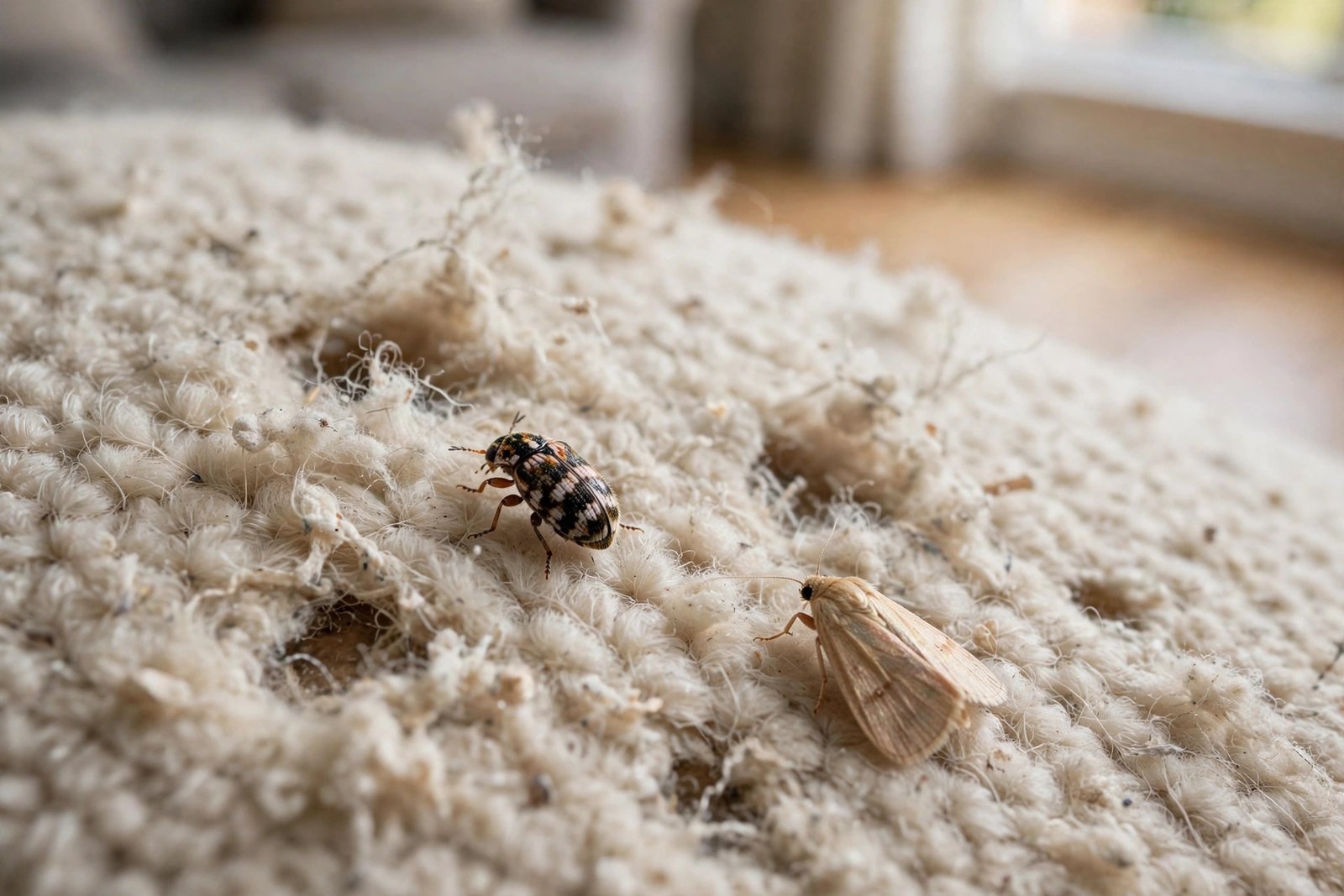
Quick answer: Look at the larva and what it leaves behind. Carpet beetle larvae are brown, hairy and about 5 mm long, and they leave dry, hairy shed skins. Clothes moth larvae are smooth, creamy white caterpillars with a dark head, and they leave silk webbing or small rice-like cases. Beetles gather on windowsills, moths hide in dark wardrobes.
You lift the corner of the rug and find a bald patch. Or you take a wool jumper out of the drawer in autumn and find holes in it. The first question is always the same: is it carpet beetles or clothes moths? The answer matters, because the two pests hide in different places and the search for the source is different, even though much of the treatment is the same. The good news is that you can usually tell them apart in a few minutes, once you know what to look for, and you do not need to be an expert to do it.
What Are Carpet Beetles and Clothes Moths?
In the British Isles there are two main types of insect that cause serious damage to textiles: clothes moths and carpet beetles. They look nothing alike and behave differently, but both eat animal fibres such as wool carpets and cashmere or mohair clothing. The damage is always done by the larvae, not the adults. Adult carpet beetles eat pollen outdoors and do no damage to fabric at all, and adult clothes moths do not feed, so they cause no damage either. It is the grubs that eat your carpet and your clothes.
The carpet beetle most people meet in Britain is the varied carpet beetle, Anthrenus verbasci. The adults are tiny, 2 to 4 mm long, with a rounded body covered in mottled scales in white, brown and black, sometimes described as a tortoiseshell pattern. A second species, the Guernsey carpet beetle, Anthrenus sarnicus, is now well established in London and the South East and is causing increasing problems elsewhere in the British Isles. The larvae are short, fat and hairy, often called woolly bears, and they grow to about 5 mm long. Their normal life cycle is one to two years, which is why a beetle problem can keep coming back long after you thought it was gone.
The clothes moths that matter in Britain are the webbing clothes moth, Tineola bisselliella, and the case-bearing clothes moth, Tinea pellionella. The webbing clothes moth is now the most common species and has become a much more marked problem in recent years. The adults of both species are small, dull, grey-fawn moths, 5 to 8 mm long, with narrow wings that fold along their backs at rest. The webbing moth has more of a golden sheen, while the case-bearing moth is more silvery-grey. One generation normally takes a year to develop, but webbing clothes moths can reproduce rapidly in heated buildings, with two generations or more per year. The adults lay batches of up to 100 eggs in dark places on fur, feathers, skin, wool or soiled silk.
One phrase causes a lot of confusion, so it is worth clearing up early. A “carpet moth” is not a separate species. It is what people call clothes moths when they find them in carpets. The insect is the same, and the treatment is the same. If a pest controller talks about carpet moths, they mean clothes moths in the carpet.
How Do You Tell Carpet Beetles From Clothes Moths?
Do not start with the holes. That is the weakest way to identify the pest, and it is where most people go wrong. Start with the larva and what it leaves behind, then use the adults and where you found them as a second check. The table below compares everything at a glance.
| Clue | Carpet beetles | Clothes moths |
|---|---|---|
| Adult | Small rounded beetle, 2 to 4 mm, mottled white, brown and black scales | Small slender moth, 5 to 8 mm, buff, golden or grey-fawn, narrow wings |
| Larva | Brown or golden-brown, hairy and bristly, about 5 mm, carrot shaped | Creamy white or pale, smooth, caterpillar-like, 8 to 10 mm, dark head |
| Best evidence | Dry, brown, hairy shed skins, 4 to 5 mm, like hollow husks | Silk webbing, silk tubes, or small portable silk cases like grains of rice |
| Damage | Irregular bald patches, pile eaten at the base, ragged edges, no webbing | Grazed thinning and bare patches, often with silk; cleaner holes in clothing |
| Where adults appear | On windowsills, in daylight, especially April to June | Low down near skirtings, in wardrobes, in the dark; weak fliers |
| Where larvae hide | Carpet edges, skirting boards, under furniture, lofts, near bird nests | Under furniture, carpet edges, wardrobes, folded wool, stored clothing |
| Likely source | Often an old bird nest, dead bird or wasp nest in the loft or chimney | Usually where the damage is: stored wool or undisturbed carpet nearby |
| What they eat | Keratin: wool, fur, feathers, silk, plus pet hair, lint and dead insects | Keratin: wool, fur, feathers, silk; soiled fabric first |
The larva is the clearest clue, so look for it first. A carpet beetle larva is brown or golden-brown, densely covered in stiff bristly hairs arranged in bands around its body, and it moves readily when disturbed. A clothes moth larva is creamy white or pale with a darker head, smooth rather than fuzzy, and shaped like a small caterpillar. If you can photograph the larva clearly beside a coin or a ruler, identification becomes much easier, and a pest controller can confirm it from the photo.
What the larva leaves behind is often easier to find than the larva itself. Carpet beetle larvae moult several times as they grow, and each moult leaves a hollow skin that keeps the exact shape of the larva. These cast skins are 4 to 5 mm long, brown-golden, hairy, and they do not rot away quickly, so they can sit at the feeding site for months. Finding a small brown hairy husk near damaged fabric is the most confident sign of carpet beetles there is. Clothes moth larvae leave silk instead. Webbing clothes moth larvae spin silk as tubes or sheets of webbing across the material they are eating, and the webbing is usually mixed with frass, the fine gritty droppings the larvae leave behind. Case-bearing clothes moth larvae spin a portable case around themselves and carry it as they feed, leaving a trail of grazed textile behind them. Empty silk cases look like grains of rice made from the carpet itself, and they are almost invisible until you know to look for them.
The adults give a second clue, and it costs nothing. Adult carpet beetles fly well in warm weather and are drawn to light, so they are often found on windowsills, especially in spring and early summer, typically April to June, when they emerge and fly to windows. Finding 2 to 4 mm mottled beetles on a windowsill in spring is a classic sign of a beetle population that has been developing indoors through the winter. Adult clothes moths do the opposite: they avoid light, prefer dark and undisturbed places, and are weak fliers that tend to scuttle or flutter low down near skirtings rather than fly across a room. A small buff moth repeatedly appearing around a dark wardrobe deserves investigation, just as a tiny beetle on a sunny windowsill does.
What Does the Damage Look Like?
Here is the honest part: the shape of the holes alone will not tell you which pest you have, and the sources disagree with each other about it. Some guides say beetle damage is scattered and irregular while moth damage is cleaner edged. Others say moths make larger continuous bare patches and beetles make small clean holes. Both cannot be right in every case, and the reason is that both insects can feed on the same materials and leave similar marks. Treat hole shape as a hint, never as proof.
What the guides do agree on is the pattern around the damage. In wool or wool-blend carpets, carpet beetle larvae eat the pile through at the base, so the tufts come away and leave a rough bald patch with irregular edges, usually at carpet edges along the skirting board line, in corners, and under furniture that is rarely moved. The central walked-on area of the carpet often looks fine while the edges are badly damaged. In stored woollen garments, beetle damage appears as irregular holes of varying sizes, often at seams, cuffs and collars, and without any webbing.
Clothes moth damage in carpets looks different in one important way: the pile is grazed down rather than eaten through at the base, so the edges of a damaged area are soft and gradual rather than sharp, and you will often find silk webbing, silk tubes or small cases in the pile. In clothing, moth damage is more often larger irregular areas, concentrated in creases, behind lapels, in pockets, and where things are folded. A better question than “what shape is the hole” is “what evidence is sitting beside the hole”. Silk points towards moths. Hairy cast skins point towards carpet beetles.
Both pests eat keratin, the protein in animal fibres, which is why wool, fur, feathers and silk are at risk and clean cotton, linen and synthetic fibres are not. Neither pest can digest cotton, linen, rayon or synthetic fibres, so they generally leave those alone. The exception is blended fabric that contains animal fibres, and cotton or linen that is stained with food, perspiration or body oils, which the larvae will chew through to reach what they want. If you find holes in a cotton shirt, check the larvae and the evidence around the damage before blaming either pest.
Where Do They Hide in a UK Home?
Both pests like dark, undisturbed places, but they spread through a house in different ways, and that difference is what makes identification worth doing. Clothes moths stay put. The adults are weak fliers, so the problem is usually where you found the damage and in the carpet or clothing directly next to it. Continuous carpet runs, a hall, stairs and landing, are the classic way moth damage spreads. If you find moth damage in one room, start your search in that room and the rooms directly joined to it.
Carpet beetles move. The adults fly properly, are drawn to light and to outdoor flowers, and they lay eggs across a whole floor. And the source is frequently not the carpet at all. Carpet beetles are often found in natural situations such as birds’ nests, wasps’ nests and animal burrows, and in some houses they have a direct route in from nests in attics and chimneys. An old bird nest in the loft, a dead bird, or a disused wasp nest can quietly produce beetles into the rooms below for months. If you have a fabric pest problem across several upstairs rooms, and beetles on the windowsills, look in the loft. Missing that source means treating twice.
For a practical inspection, work through these places in order. Lift carpet edges along skirting boards, especially in bedrooms, and look underneath. Move furniture that is rarely shifted and check the carpet beneath it. Open wardrobes and check the floor, the lower shelves, and stored woollen garments. Look in the loft for cast skins near bird nest material and stored woollens, and check chimney breasts where birds may have nested. A torch, a white card and clear tape help: tape-lift anything suspicious onto the white card, where skins, pellets and larvae stand out clearly. Pheromone sticky traps can confirm which pest is present and give a rough idea of numbers, but they are a monitoring tool, not a treatment on their own.
Which Is Worse, Carpet Beetles or Clothes Moths?
There is no useful universal winner. The worse infestation is the one that is established, hidden and still feeding. A small clothes moth infestation limited to one stored garment can be easier to resolve than carpet beetle larvae spread across several rooms. A major clothes moth infestation throughout an expensive wool carpet can cause far more damage than a few carpet beetles feeding around one isolated source. Severity depends on the size of the infestation, where it is, how long the insects have been active, and whether the source can be found and removed.
One difference is worth knowing when you plan the work. Because beetle adults fly and lay eggs widely, a beetle problem can be present across multiple rooms of a house by the time the first damage is noticed, and the larvae can take one to two years to complete development, so they can keep feeding long after the first treatment. Moth problems tend to stay closer to the source, which makes them easier to contain, but webbing clothes moths can reproduce rapidly in heated buildings, with two generations or more per year, so a moth problem left alone can grow fast.
You can also have both at the same time. Finding one pest does not make the other impossible. A house with wool carpet, stored textiles, pet hair, rugs and quiet storage spaces can suit more than one textile pest at once. That is another reason a single moth trap or one adult insect should not be treated as a complete diagnosis. Inspect the damaged area itself before you decide what you are dealing with.
How Do You Get Rid of Them, and Does Treatment Differ?
Much of the treatment is the same for both pests, which is why identification is about finding the source rather than choosing a different spray. Our guide to how to get rid of carpet beetles sets out the full routine in detail: thorough vacuuming including under furniture and along carpet edges, steam cleaning where possible, washing or dry cleaning affected soft furnishings at a high temperature, and repeat treatment over several weeks, because eggs hidden deep in fibres are hard to reach in one pass. The table below shows where the two pests need different attention.
| Step | Carpet beetles | Clothes moths |
|---|---|---|
| Find the source | Check the loft and chimneys for old bird nests, dead birds and wasp nests; check pet resting areas and lint-filled gaps | Check stored wool, wardrobes and the carpet directly around the damage; moths stay near the source |
| Vacuum and steam | Vacuum edges, skirting boards, under furniture and in wardrobes; steam clean carpet where possible | Same: vacuum and steam the damaged carpet and the rooms joined to it |
| Wash or freeze items | Wash or dry clean affected textiles; small items can be frozen at minus 18 degrees for two weeks to kill all stages | Same: wash, dry clean or freeze; pay attention to folded wool and stored clothing |
| Traps | Pheromone traps exist for some beetle species and help monitor numbers | Pheromone traps for webbing clothes moths break the breeding cycle by catching males; use them to monitor, not as the whole treatment |
| Sprays and powders | Residual sprays and boric acid on carpets, used carefully and tested on a hidden area first | Residual sprays around carpet edges and in wardrobes; hanging sachets in enclosed spaces |
| Prevention | Remove old nests from lofts and disused chimneys after the nesting period; clear roof spaces | Store clean wool in airtight containers; vacuum dark, undisturbed areas regularly |
Two non-chemical treatments are worth knowing about, because they work on both pests and on every life stage. Sealing infested carpets or wool clothing in plastic bags and freezing them at minus 18 degrees for two weeks will kill all stages of insect life. Heating objects to 55 degrees or more will kill all insect stages in an hour, but great caution is needed to make sure the objects are not damaged by the very dry hot air. Mothballs, on the other hand, are no longer a safe default: many traditional insecticides such as mothballs are now banned under the Biocides Directive, and others are likely to follow, so check the label and the current rules before using any old product you find in a cupboard.
Call a professional pest controller if the infestation is widespread across multiple rooms, keeps returning after repeated home treatment, involves valuable rugs or carpets you are reluctant to treat with chemicals yourself, or if the source is in a loft or chimney you cannot safely reach. A professional can apply stronger, more targeted treatments, including whole-room heat treatment that reaches eggs hidden deep in fibres and floor edges that sprays and vacuuming alone often miss. A full property inspection matters more than a single room, because a bedroom infestation can produce adults that lay eggs in a downstairs wool rug within a season.
Do Carpet Beetles or Clothes Moths Bite?
Neither of them bites. Carpet beetles do not feed on people, and clothes moths are textile pests, not blood-feeding insects. If unexplained skin marks are appearing, do not assume either pest is responsible. Bed bugs, fleas and mosquitoes are more likely causes, and skin symptoms have many causes, so look for actual insects and textile evidence before identifying the pest.
There is one skin effect worth knowing about. The hairs on carpet beetle larvae can irritate the skin of sensitive individuals, so something that looks like a carpet beetle bite may really be irritation from larval hairs rather than an actual bite. Wear gloves when you handle infested textiles, wash your hands afterwards, and vacuum up shed skins rather than brushing them into the air.
Frequently Asked Questions
Can I tell carpet beetles from clothes moths just by the holes they leave?
No, not reliably. The sources disagree with each other on hole shape, and both insects can leave similar marks on the same materials. Use the larva and the evidence beside the hole instead: hairy shed skins mean beetles, silk webbing or small silk cases mean moths.
What is a carpet moth? Is it different from a clothes moth?
No. A carpet moth is not a separate species. It is what people call clothes moths when they find them in carpets. The insect, the damage and the treatment are the same.
Can I have carpet beetles and clothes moths at the same time?
Yes. Finding one does not rule out the other. A house with wool carpet, stored textiles and quiet storage spaces can suit both pests at once, so inspect the damaged area itself rather than assuming one diagnosis covers everything.
Do carpet beetles eat clothes and moths eat carpets, or is it the other way round?
Both eat both. Carpet beetle larvae and clothes moth larvae both feed on keratin in wool, fur, feathers and silk, so either one can damage carpets and clothing. Neither eats clean cotton, linen or synthetic fibres, though both will chew through stained cotton or blends that contain animal fibres.
How long does it take to get rid of them completely?
Expect to repeat vacuuming and treatment over several weeks, because eggs hidden deep in fibres can survive an initial treatment pass. Beetle larvae can take one to two years to complete development, so keep checking the loft source and the carpet edges for months after the damage stops appearing.
When should I call a pest controller?
When the infestation covers several rooms, keeps returning after repeated home treatment, involves valuable rugs you do not want to treat yourself, or when the source is an old nest in a loft or chimney you cannot safely reach. A professional inspection of the whole property, not just the first damaged room, is the right step.
The fastest way to settle the question is a torch and ten minutes. Lift a carpet edge, look under the furniture, and check what is sitting beside the damage. A brown hairy husk means carpet beetles. Silk webbing or a small rice-like case means clothes moths. Once you know which one it is, you know where to look, and that is half the treatment done.