
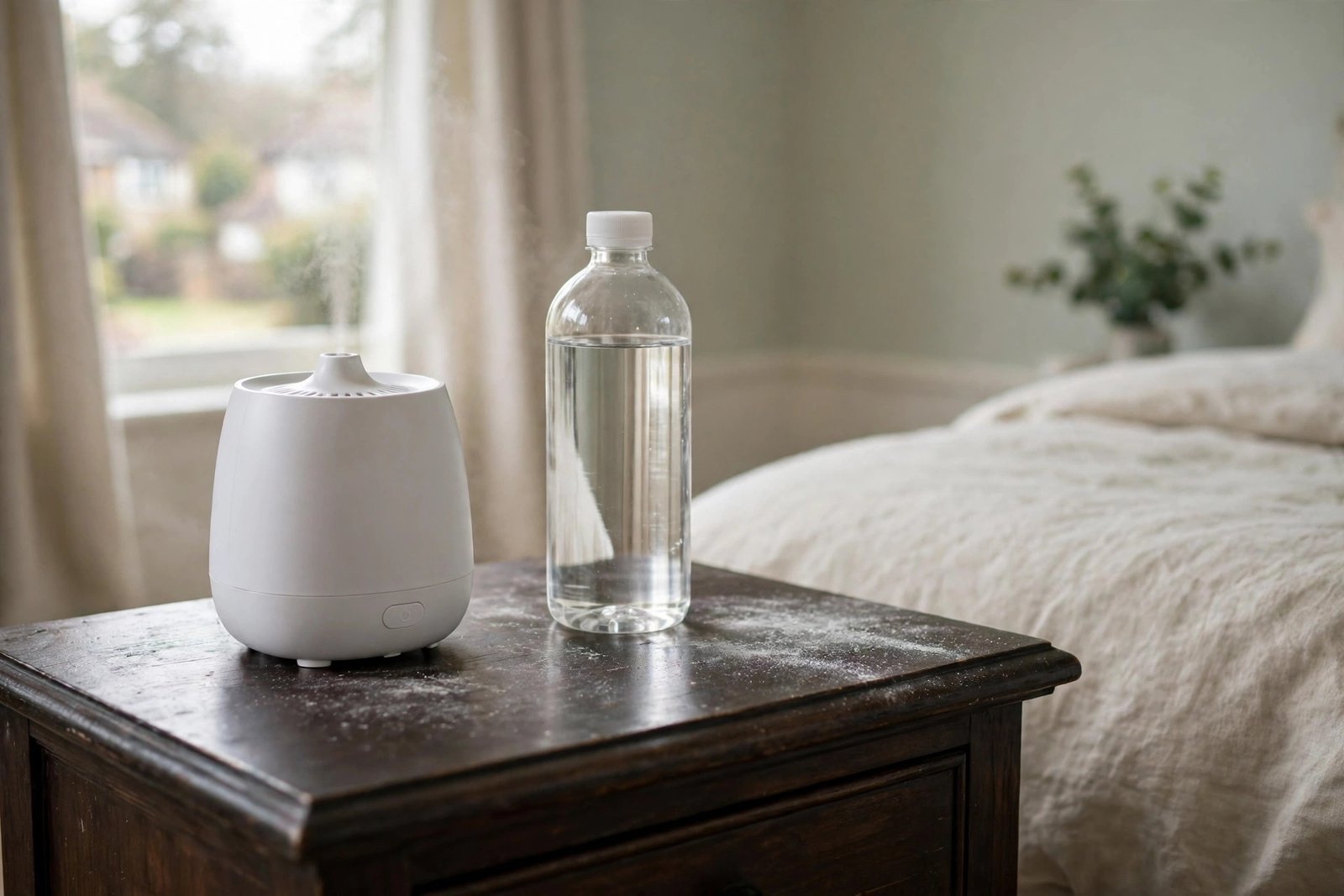
Quick answer: The white dust is minerals from hard tap water, thrown into the air by ultrasonic humidifiers. The fix is to fill the tank with distilled or demineralised water, which has the minerals removed. If that is not practical, fit a demineralisation cartridge or switch to an evaporative humidifier, which leaves the minerals behind.
You wipe the bedside table on Monday, and by Friday it is white again. The television, the bookshelf and the top of the radiator have the same fine film. The humidifier is doing its job, the air feels better, but everything in the room is slowly turning dusty. It is not a fault in the machine, and it is not ordinary household dust. It is the minerals from your tap water, and the fix is in the water you put in the tank, not in the machine itself.
What Is the White Dust From a Humidifier?
White dust is the mineral content of your tap water, mainly calcium and magnesium, left behind when the water evaporates. An ultrasonic humidifier works by vibrating a metal disc at high frequency, which shatters the water into a fine cool mist. It does not remove anything from the water first, so the minerals ride out in the mist along with the moisture. When the droplets dry on your furniture, the minerals settle as a fine white powder. The same thing happens with impeller humidifiers, which use a rotating disc to throw the water into the air.
Whether you get white dust depends on two things: the type of humidifier and the hardness of your water. Evaporative humidifiers do not make white dust at all, because a fan blows air through a wet wick and only pure water vapour leaves the machine, while the minerals stay trapped in the wick. Steam and warm mist humidifiers boil the water, so the minerals stay behind in the reservoir as scale instead of going into the air. The dust problem belongs almost entirely to ultrasonic and impeller models running on hard tap water.
How hard your water is makes a big difference. The US Geological Survey classes water above 120 milligrams per litre of dissolved calcium and magnesium as hard, and above 180 as very hard. In Britain, the hard water half of the country, London, the South East and East Anglia especially, is where the dust shows up fastest. If you live in a soft water area, in much of Scotland, Wales and the North West, you may never see white dust at all, even with an ultrasonic humidifier and tap water. A quick check is the kettle: heavy limescale inside the kettle means hard water, and hard water means white dust.
Is Humidifier White Dust Harmful?
The honest answer is that nobody knows for sure, and the authorities do not agree with each other. The US Consumer Product Safety Commission says the minerals released in the mist settle as a fine white dust that may contain particles small enough to enter the lungs, and that the health effects are not clear and depend on the types and amounts of minerals in your water. The US Environmental Protection Agency goes further: it says breathing mist containing these pollutants has been implicated in a type of lung inflammation, and that the young, the elderly and people with lung disease or respiratory allergies may be particularly susceptible.
Other voices are more relaxed. The Mayo Clinic describes white dust as generally not a health concern for most people, while advising anyone who develops respiratory symptoms around a humidifier to stop using it and talk to a clinician. Some manufacturers, including Crane and Vicks, call the dust harmless. The American Lung Association takes the cautious side, warning that the fine particles can reach the alveoli, the parts of the lungs where oxygen passes into the blood, and can irritate the respiratory system and make asthma worse.
For most healthy adults, the occasional white film is a cleaning nuisance rather than a health threat. The extra caution applies to babies, children, older people and anyone with asthma or another lung condition. The medical literature also carries a reported case from 2011, in the journal Pediatrics, of lung injury in an infant after prolonged exposure to white dust from an ultrasonic humidifier in the baby’s room. That is one case, not a pattern, but it is a good reason to be extra careful about the water you use in a nursery. If you develop a cough, wheeze or any breathing symptoms you associate with your humidifier, the EPA’s advice is simple: stop using it and contact a physician.
There is one risk that is clearer than the dust itself, and it is the scale inside the tank. The EPA says mineral scale can become a breeding ground for microorganisms, which is why the water you use and the cleaning routine matter together. Our guide to how to clean a humidifier sets out the full routine, including the vinegar soak and the daily water change.
How Do You Stop a Humidifier Leaving White Dust?
Work through these in order. The first one solves the problem for almost everyone, and each step down the list is for people the previous step does not suit.
Step 1: Switch to Distilled or Demineralised Water (The Complete Fix)
This is the fix the EPA recommends first, and it is the only one that removes the cause entirely. Distilled water has had its minerals taken out by boiling and condensing the steam, so its dissolved solid content is near zero. Demineralised and deionised water, the kind sold as ironing water, has had its minerals taken out by a different process, but the result for a humidifier is the same: almost nothing to turn into dust. Fill the tank with it and an ultrasonic humidifier produces no white dust at all.
Read the label before you buy. The EPA says to look for bottled water labelled “distilled”, because distillation is the most effective way to remove minerals. Water labelled “spring”, “artesian” or “mineral” has not had its minerals removed at all, and will make dust just like tap water. Demineralised and deionised water sold for steam irons is fine for a humidifier, and it is usually the cheapest option on a supermarket shelf. A standard kitchen jug filter is not a substitute: it takes out some hardness and improves the taste, but it does not bring the mineral content down anywhere near zero.
The catch is the cost and the carrying. A 4 litre tank refilled daily uses about 28 litres of distilled water a week, so you will be buying and carrying water every week for as long as the humidifier runs. That is why many people try the cartridge first, or change the type of humidifier, even though the water is the better fix.
Step 2: Fit a Demineralisation Cartridge (The Halfway Fix)
Many ultrasonic humidifiers accept a small cartridge that sits in the tank and traps minerals before they reach the mist. The EPA lists these as the second choice after distilled water, if they are supplied with or recommended for your model. It also warns that their ability to remove minerals may vary widely, and it gives a simple test: if white dust appears, the cartridge is not removing the minerals.
Cartridges exhaust, and a cartridge past its life is a cartridge that has stopped doing anything. HoMedics gives specific guidance for its UHE-HDC4 cartridge: replace it every 30 to 40 fillings, sooner with very hard water or whenever white dust increases. At one filling a day, that is roughly a month of use per cartridge. If the dust persists with a new cartridge fitted, HoMedics says to switch to distilled water. Only buy a cartridge made for your model, because a cartridge that does not fit properly will not trap minerals at all.
Step 3: Switch to an Evaporative or Steam Humidifier (The Permanent Fix)
If buying distilled water every week is not realistic, changing the type of humidifier ends the dust problem for good. An evaporative humidifier draws air through a wet wick with a fan, and only pure water vapour leaves the machine, so the minerals stay trapped in the wick and tap water can generally be used without issue. A steam or warm mist humidifier boils the water, so the minerals stay in the reservoir as scale and never reach the air.
You trade dust for maintenance. An evaporative model needs its wick replaced from time to time, and a steam model needs its chamber descaled. An evaporative model is also self regulating: it cannot easily push the humidity past the point where the air is saturated, which is a useful safety net in a British home where damp is already a worry. If you are buying a humidifier for a hard water area, treat the type as the deciding feature, not an afterthought.
Which Water Should You Use in a Humidifier?
The table below compares every water you might put in a humidifier. The rule is simple: the fewer dissolved minerals in the water, the less white dust on your furniture.
| Water type | White dust | Cost in the UK (approx.) | Notes |
|---|---|---|---|
| Tap water, hard area | Yes, worst | Free | The cause of the dust; London, South East and East Anglia are worst hit |
| Tap water, soft area | Little or none | Free | If your water is soft, dust is rarely a problem at all |
| Distilled water | No | About 3 to 10 pounds for 5 litres | The complete fix; look for “distilled” on the label |
| Demineralised or deionised water | No | About 3 to 7 pounds for 5 litres | Same result as distilled; ironing water is the cheap everyday buy |
| Filtered water, jug filter | Reduced, not removed | Cost of the filter | Not a substitute for distilled water |
| Softened water | Still yes | Cost of the softener | Ion exchange swaps calcium for sodium, and sodium becomes dust just as readily |
| Spring or mineral water | Yes | Bottled water prices | Minerals not removed; do not use in a humidifier |
Prices are approximate, checked in November 2026, and vary by retailer. Deionised water sold for irons was listed from about 2.76 pounds for a 5 litre bottle to about 6.99, while distilled water sold online was listed from about 6.45 pounds ex VAT to about 10.19 for 5 litres. The supermarket ironing water aisle is usually the cheapest place to buy it, and a 5 litre bottle is far better value than small bottles.
How Much Does It Cost to Stop the White Dust in the UK?
The cheapest fix in the short term is not always the cheapest over a winter. The table below compares the real cost of each option, so you can pick the one that fits how much you run the humidifier.
| Fix | Dust stopped | Cost (approx.) | Effort |
|---|---|---|---|
| Distilled or demineralised water | Completely | About 3 to 10 pounds per 5 litres; a 4 litre tank a day is about 28 litres a week | Buy and carry water weekly; nothing to fit |
| Demineralisation cartridge | Mostly, varies by model | Price varies by model; one cartridge lasts 30 to 40 fillings | Fit once, replace about monthly |
| Evaporative humidifier | Completely | Cost of a new machine, plus wick replacements | Buy once; change the wick from time to time |
| Steam or warm mist humidifier | Completely | Cost of a new machine; descale the chamber | Buy once; more energy to run |
| Cleaning alone | No, dust continues | Vinegar and time | Helps the machine, not the dust |
A worked example makes the water cost concrete. A small bedroom humidifier with a 4 litre tank, refilled once a day, uses about 28 litres of distilled water a week. At about 3 to 7 pounds for 5 litres of demineralised water, that is roughly 17 to 39 pounds a week at the cheapest prices, which is a lot for a whole winter. In practice most people do not run a humidifier at full output all day, and a smaller tank or shorter running hours cuts the weekly use a lot. If the numbers do not add up for you, the cartridge or a different type of humidifier is the better buy.
Why Is My Humidifier Still Leaving White Dust?
If you have changed the water or fitted a cartridge and the dust is still there, one of these is usually the reason.
- The cartridge is exhausted. A cartridge past its 30 to 40 fillings has stopped trapping minerals. Replace it and see if the dust clears within a day or two.
- Old scale is still inside the machine. Changing to distilled water does not remove the mineral crust already in the tank and on the misting disc. Descale first with white vinegar, then start with clean water.
- The water is not what the label suggests. “Spring” and “mineral” water still carry minerals, and so does softened water. Only distilled, demineralised or deionised water is low enough in minerals to stop the dust.
- The cartridge does not fit your model. A cartridge made for a different humidifier may sit in the tank without sealing properly, so the water flows around it instead of through it.
- The dust is not from the humidifier. If the film appears on surfaces far from the machine, or in rooms where it never runs, check for plaster dust, building work or a different source before blaming the humidifier.
How Often Should You Clean a Humidifier to Keep the Dust Away?
Cleaning alone will not stop white dust, because the minerals come from the water, not from dirt. But cleaning stops the scale that makes the dust worse and gives bacteria somewhere to grow, so the two jobs go together. The EPA recommends cleaning portable humidifiers every third day and emptying and drying the tank daily. Our own guide, how to clean a humidifier, sets out the full routine: a 50/50 mix of white vinegar and water, soaked for 30 to 60 minutes to dissolve mineral deposits, then scrubbed, rinsed and air dried completely before refilling.
Two safety rules belong in every cleaning routine. Never submerge the base unit that holds the motor and electrical parts in water; wipe it with a damp cloth instead. And never mix vinegar and bleach, because the mixture can release dangerous chlorine gas. Descaling and disinfecting are separate jobs, done one at a time, with a thorough rinse between them.
One more thing the humidifier affects is the damp in the room. A humidifier running too hard in a British winter can push the humidity past 60 percent, and above that level you are feeding the condensation and mould problem the country already has. The comfortable range is 40 to 50 percent relative humidity, and the NHS puts the healthy range at 40 to 60 percent. If you see condensation on the windows in the morning, turn the humidifier down or run it for fewer hours. If mould does appear, our guide to how to get rid of mould on walls and fabric covers the fix.
Frequently Asked Questions
Is humidifier white dust harmful?
For most healthy adults it is a cleaning nuisance rather than a health threat, but the honest answer is that the effects are not clear. The CPSC says the dust may contain particles small enough to enter the lungs. Take extra care in a baby’s room and if anyone in the house has asthma or a lung condition.
Can I use filtered water instead of distilled water?
A kitchen jug filter is not enough. It takes out some hardness but does not bring the mineral content down anywhere near zero, so the dust will be reduced, not removed. Use distilled, demineralised or deionised water.
Does a demineralisation cartridge stop white dust completely?
Not always. The EPA warns that a cartridge’s ability to remove minerals may vary widely. Its simple test is that if white dust appears, the cartridge is not removing the minerals, and you should switch to distilled water.
How often should I replace a demineralisation cartridge?
HoMedics says every 30 to 40 fillings, sooner with very hard water or whenever white dust increases. At one filling a day that is roughly a month of use per cartridge.
Can I use softened water in my humidifier?
No. A water softener swaps calcium for sodium, and the sodium becomes airborne dust just as readily as the calcium did. Softened water does not solve the problem.
When should I replace the humidifier?
When the misting disc is caked in scale that will not come off, when the tank is cracked, or when the machine no longer holds a steady mist after a full clean. A humidifier that still works well is worth keeping: change the water, not the machine.
White dust is a water problem, not a machine problem, and that is good news. Change the water and it stops. The cheapest way to do that is a bottle of demineralised water from the supermarket, the most certain way is distilled water, and the most permanent way is a humidifier that never throws minerals into the air in the first place. Pick the one that fits your home, and the bedside table will stay the colour it started.