
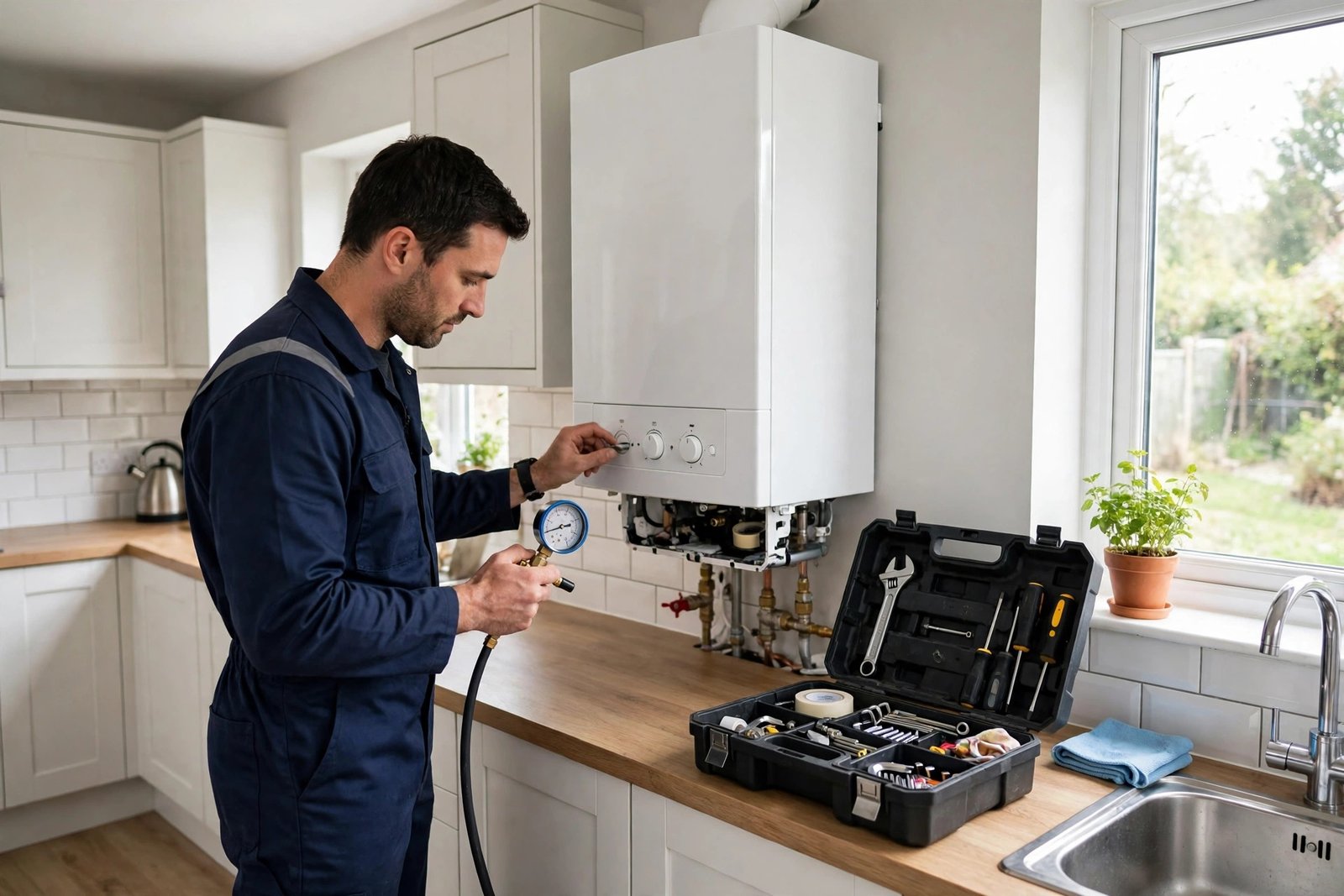
Quick answer: A boiler should be serviced once every 12 months in the UK, whether it runs on gas, oil or LPG. The HSE advises an annual service by a Gas Safe registered engineer, most manufacturers make it a condition of the warranty, and landlords must have a gas safety check every 12 months by law.
Every guide gives the same one-line answer: once a year. That is correct, but it leaves the useful questions unanswered. Does the law actually require it, or is it only advice? What does the visit cost for your type of boiler, and what should the engineer actually do while they are there? What happens to your warranty if you skip a year, and is a landlord gas safety check the same thing as a service? This guide answers all of them, with UK prices and the rules as they stand in November 2026.
How Often Should a Boiler Be Serviced in the UK?
Once a year, every 12 months, for every common boiler type. Gas, oil and LPG boilers all follow the same annual rhythm, and electric boilers are best checked on the same schedule even though they have no flue and no combustion to test. The Health and Safety Executive strongly advises that all gas appliances, flues and pipework are serviced at least annually by a Gas Safe registered engineer. Manufacturers say the same in their own words: Vaillant, Worcester Bosch, Baxi and Ideal all make an annual service a condition of their guarantee. The only thing that changes from one household to the next is whether the annual visit is a legal duty, a warranty condition or simply good sense.
| Your situation | How often to service | What applies |
|---|---|---|
| Owner-occupier, boiler out of warranty | Every 12 months | No legal duty to service, but the HSE advises at least annually |
| Owner-occupier, boiler under warranty | Every 12 months | Annual service is a guarantee condition for Worcester Bosch, Vaillant, Baxi and Ideal |
| Private or social landlord | Every 12 months | Annual gas safety check is a legal duty, plus a maintenance duty on the appliances |
| Tenant | Ask your landlord | Your landlord arranges the check and must give you a copy of the record |
| Oil boiler, any household | Every 12 months | OFTEC recommends servicing at least once a year; manufacturers require it for warranty |
| Electric boiler, any household | Every 12 months | No gas or flue checks, but an annual check of electrics, seals and controls is still advised |
Count the 12 months from the installation date on a new boiler, or from the last service on an older one, and keep the service record with the boiler paperwork. A new boiler needs its first service within 12 months of fitting even though it is brand new, because the warranty depends on it. Worcester Bosch also needs the boiler registered within 30 days of fitting, and Baxi warranties of two to ten years are subject to registration within 30 days and an annual service. If you are not sure which type you have, our guide to boiler types explains combi, system and heat-only boilers in plain English.
Is an Annual Boiler Service a Legal Requirement?
For most homeowners, no. There is no law that says an owner-occupier must service their own boiler. The HSE strongly advises it, and the manufacturer requires it for the warranty, but the law itself does not force it. The one legal point that does apply to homeowners is safety: it is illegal to use a gas appliance you know or suspect is unsafe, so a boiler showing warning signs cannot simply be left running until it is convenient.
For landlords the position is different, and it is set out in the Gas Safety (Installation and Use) Regulations 1998. A landlord must have an annual gas safety check carried out on every gas appliance and flue they provide, within 12 months of installation and annually after that, by a Gas Safe registered engineer. The record of the check must be kept for two years, a copy must go to each existing tenant within 28 days of the check, and new tenants must get a copy before they move in. Since the 2018 amendment, the check can be done up to two months early while keeping the original deadline date, which works like an MOT renewal window and stops the date creeping earlier every year. Our guide to the gas safety certificate covers the landlord rules in full, including what the certificate must record.
How Much Does a Boiler Service Cost in the UK?
A one-off gas boiler service typically costs £80 to £120, with a UK average of about £100, according to Checkatrade’s cost guide updated in March 2026. British Gas charges from £119 for a one-off service, Vaillant quotes £70 to £160 depending on where you live and who books it, and HomeServe puts the average at £100 to £130, with its own service at £126 a year or £10.50 a month. The spread is wide because the price depends on the boiler type, the area and whether parts are needed, so the table below gives the range for each fuel type rather than a single figure.
| Boiler type | Typical one-off service cost | Average | How long it takes | Who must do it |
|---|---|---|---|---|
| Gas combi, system or regular | £80 to £120 | About £100 | 40 to 60 minutes | Gas Safe registered engineer |
| Oil boiler | £75 to £140 plus VAT | About £92 to £110 | 1.5 to 2 hours | OFTEC registered engineer |
| Electric combi boiler | £70 to £110 | About £90 | About an hour | Qualified electrician or heating engineer |
| LPG boiler | £80 to £140 | About £100 to £120 | About an hour | Gas Safe registered engineer with LPG competence |
The cost figures in the table are ranges from Checkatrade (March 2026), British Gas, Vaillant, HomeServe and oil specialists Boilerhut and Walsh Solutions, all checked in November 2026. Oil costs more than gas in most guides because the burner has more parts to strip and clean and the nozzle is replaced every year. London and the South East cost more than the rest of the country: oil guides put London at £100 to £160 against £80 to £130 elsewhere. A monthly cover plan is the alternative to paying per visit: boiler cover typically costs £8 to £13 a month, and boiler plus central heating cover runs £180 to £300 a year, according to Checkatrade. Cover usually includes the annual service, but excesses, repair limits and boiler age rules vary by provider and plan, so read the terms before you compare it with a one-off price.
A worked example shows what the annual habit costs over a boiler’s life. Take a gas combi boiler serviced every year at the £100 average. Over ten years that is £1,000. Over the same ten years, a single emergency breakdown callout in winter, with parts and labour, can easily cost several hundred pounds on its own, and a boiler that has never been serviced is the one most likely to need it. The service is not cheap insurance against every breakdown, and no honest guide can promise that, but the arithmetic is simple: a hundred pounds a year is a small, predictable cost against an unpredictable one, and it is the price of keeping the warranty valid at the same time.
What Does a Boiler Service Actually Include?
A proper service is a strip-down and test, not a glance at the pressure gauge. The exact checklist varies by make and model, because the engineer follows the manufacturer’s servicing instructions for your boiler, but a full gas service should cover the checks below. If your engineer is in and out in ten minutes, ask what was actually done, because a real service takes 40 to 60 minutes on a gas boiler and up to two hours on an oil boiler.
- A visual inspection of the boiler, flue and pipework, looking for leaks, corrosion and damage
- A check of the flue, inside and outside, to make sure combustion gases are leaving the house safely
- Cleaning and inspection of the burner and the heat exchanger
- A gas pressure and gas rate check, to confirm the boiler is burning the right amount of gas
- Inspection of seals, gaskets and the condensate trap, and cleaning the trap where it is fitted
- A check of the controls, thermostat and safety devices, including the pressure relief valve
- A carbon monoxide check and a flue gas analysis, to confirm the boiler is burning cleanly
- A written service record, which is what your warranty and your landlord records depend on
An oil service has its own extra steps. The burner is stripped and cleaned, the nozzle is replaced every year, the oil filter is checked, the tank is inspected, and the visit ends with a combustion test recorded on an OFTEC CD/11 form. That form is the oil equivalent of the gas service record, and it is worth keeping with the boiler paperwork. A gas boiler service must only be carried out by a Gas Safe registered engineer, and an oil boiler service by an OFTEC registered engineer, because gas qualifications do not cover oil burners or tanks, and the other way round.
What Is the Difference Between a Boiler Service and a Gas Safety Check?
People use the two terms as if they mean the same thing, and for landlords the confusion matters, because the law requires one of them and not the other. A gas safety check is a safety test. A boiler service is maintenance. A landlord must have the safety check every year, and should combine it with a full service in the same visit, which most engineers will do if you ask. The table below sets out the difference.
| Boiler service | Gas safety check | |
|---|---|---|
| Purpose | Maintenance: clean, test and tune the boiler so it runs safely and efficiently | Safety test: confirm the appliances and flues are safe to use |
| What it covers | Full strip-down, cleaning, gas rate, flue gas analysis, safety devices | Gas tightness, burner pressure, flue flow, ventilation, safety devices, carbon monoxide |
| Legally required? | No for homeowners; a warranty condition for most new boilers | Yes for landlords, every 12 months, under the 1998 Regulations |
| How long it takes | 40 to 60 minutes for gas, up to 2 hours for oil | About 30 to 60 minutes, often done in the same visit as a service |
| Record you get | Service record for your warranty and boiler paperwork | Gas safety record, kept 2 years, copy to tenants within 28 days |
| Who can do it | Gas Safe registered engineer | Gas Safe registered engineer |
The practical point is simple. A safety check alone will not clean the burner, replace a worn seal or keep a warranty valid, and a service alone does not produce the gas safety record a landlord must hold. If you are a landlord, book both in one visit and keep both records. If you are a homeowner, the service is the one that matters, and the safety checks inside it are part of the job.
What Happens If You Skip a Boiler Service?
The first thing you lose is the warranty. Worcester Bosch, Vaillant, Baxi and Ideal all make an annual service a condition of their guarantee, so a missed year can leave you paying for a repair that would have been covered. The second cost is efficiency. A burner and heat exchanger that have never been cleaned build up soot and scale, and the boiler burns more gas for the same warmth, which shows up on the bill long before anything breaks. The third cost is the breakdown itself: the guides agree that a neglected boiler is more likely to fail, and it is most likely to fail in the depths of winter, when engineers are busiest and callout prices are highest. A well-maintained gas boiler should last 10 to 15 years, according to Baxi, and a well-maintained oil boiler 15 to 20 years. Skipping services does not guarantee an early failure, but it is the fastest way to shorten that life.
The safety risk is the one that matters most. A boiler that is not checked can develop a blocked flue, a cracked heat exchanger or a burner fault that produces carbon monoxide, a gas with no smell, colour or taste. That is why the HSE lists warning signs such as yellow or orange flames, soot or staining around the boiler and pilot lights that keep blowing out, and why an annual service is the point at which those faults are found. Missing one year is unlikely to be dangerous on its own. Missing several years in a row is how a small fault becomes a serious one.
When Is the Best Time of Year to Book a Boiler Service?
Late spring or summer is the best time, and British Gas gives the same advice. The heating is off or barely used, so a day without it costs you nothing, and engineers have more free slots, which means you can pick a date that suits you instead of taking whatever is left. Booking in summer also means the boiler is checked and clean before the heating goes back on in autumn, which is when most breakdowns happen. The worst time is the first cold week of winter, when every neglected boiler in the country fails at once and the waiting list stretches for days.
Landlords have one extra timing rule worth using. Since the 2018 amendment, the annual gas safety check can be carried out up to two months before the deadline while keeping the original deadline date, so a landlord can book in summer and still keep the same anniversary every year. For everyone else, the simplest habit is to book the service in the same month every year, and to put a reminder in the calendar for the month after the boiler was installed, so the 12-month rhythm never slips.
What Are the Signs Your Boiler Needs a Service Sooner Than 12 Months?
The annual rhythm is for a healthy boiler. If yours is showing any of the signs below, book a visit now rather than waiting for the anniversary. Some of these are maintenance issues. Two of them are safety issues, and the HSE lists them as signs a gas appliance is not working properly.
- A yellow or orange flame instead of a crisp blue one, or a pilot light that keeps blowing out. The HSE lists both as signs a gas appliance is not working properly. Stop using the boiler and call a Gas Safe registered engineer. If you smell gas, leave the property and call the National Gas Emergency Service on 0800 111 999.
- Soot, or yellow and brown staining, on or around the boiler, or more condensation than normal on the inside of the windows. Both are listed by the HSE as warning signs.
- Kettling, banging, gurgling or whistling noises. Kettling is usually limescale or sludge on the heat exchanger, and a boiler that has got louder year on year is wearing out.
- Pressure that keeps dropping. A gauge that sits between 1 and 2 bar when the heating is off is normal, but if you are topping the pressure up every few days or weeks, there is almost certainly a leak or a fault with the expansion vessel. Our guide to correct boiler pressure explains the range and how to top it up safely.
- Water around the boiler or damp patches on the wall. Any leak should be checked, because it can come from a worn seal, a faulty valve or internal corrosion. Our guide to a boiler leaking water covers the common causes and what to do first.
- Heating bills that have risen with no change in how you use the heating. An inefficient boiler burns more gas for the same warmth, and scale or a failing part is the usual cause.
- Radiators that take much longer to warm up than they did last winter, or hot water that is slow or lukewarm. Both point to scale, sludge or a struggling boiler.
- The boiler cuts out mid-cycle, or shows a fault code. Repeated faults are a sign the boiler needs attention, not just a reset. Our guide to boiler fault codes explains the common codes and what they mean.
How Do You Book a Boiler Service and Check the Engineer?
Book with a registered engineer, and check the registration before they start work. For a gas boiler, the engineer must be on the Gas Safe Register, and you can check them on the Gas Safe Register website or by calling 0800 408 5500. Ask to see the engineer’s Gas Safe ID card when they arrive, and check the back of the card, because it lists the categories of gas work they are qualified to do. For an oil boiler, the engineer must be OFTEC registered, and for an LPG boiler the engineer needs LPG competence on their Gas Safe card. Anyone employed to work on gas appliances in a home must be Gas Safe registered, and it is the homeowner’s job to check.
When you book, ask three questions. First, what is included in the price, and does it include parts such as a new nozzle on an oil boiler. Second, will you get a written service record at the end of the visit. Third, how long will they be on site, because a ten-minute visit is not a service. Keep the record with the boiler paperwork, and keep it for the life of the boiler, because it is the proof your warranty depends on and the record a buyer will ask for when you sell the house.
Frequently Asked Questions
How often should a gas boiler be serviced?
Once a year, every 12 months. The HSE advises an annual service by a Gas Safe registered engineer, and manufacturers such as Worcester Bosch, Vaillant, Baxi and Ideal make it a condition of the warranty.
Do I legally have to service my boiler?
No, if you own your home. There is no law requiring an owner-occupier to service a boiler. Landlords are different: they must have an annual gas safety check by law, and they have a maintenance duty on the appliances they provide.
How much does a boiler service cost in the UK?
A gas boiler service typically costs £80 to £120, with an average of about £100. An oil boiler service costs about £75 to £140 plus VAT, and an electric combi boiler about £70 to £110. Prices are higher in London and the South East.
How long does a boiler service take?
A gas boiler service takes 40 to 60 minutes. An oil boiler service takes longer, about 1.5 to 2 hours, because the burner is stripped and cleaned and the nozzle is replaced.
What is the difference between a boiler service and a gas safety check?
A service is maintenance: cleaning, testing and tuning the boiler. A gas safety check is a safety test that confirms the appliances and flues are safe. Landlords legally need the check every year; the service is what keeps the boiler efficient and the warranty valid.
Does an oil boiler need servicing every year?
Yes. OFTEC recommends oil-fired boilers, tanks and equipment are serviced at least once a year, and manufacturers such as Grant and Worcester Bosch require an annual service by an OFTEC registered engineer to keep the warranty valid.
The short version is simple. Once a year, every 12 months, by a registered engineer, in summer if you can choose the date. It costs about £100 for a gas boiler, it takes about an hour, and it is the one visit that keeps your warranty valid, your bills down and your boiler safe. Put the date in the calendar the day the service is done, and the next one will take care of itself.