
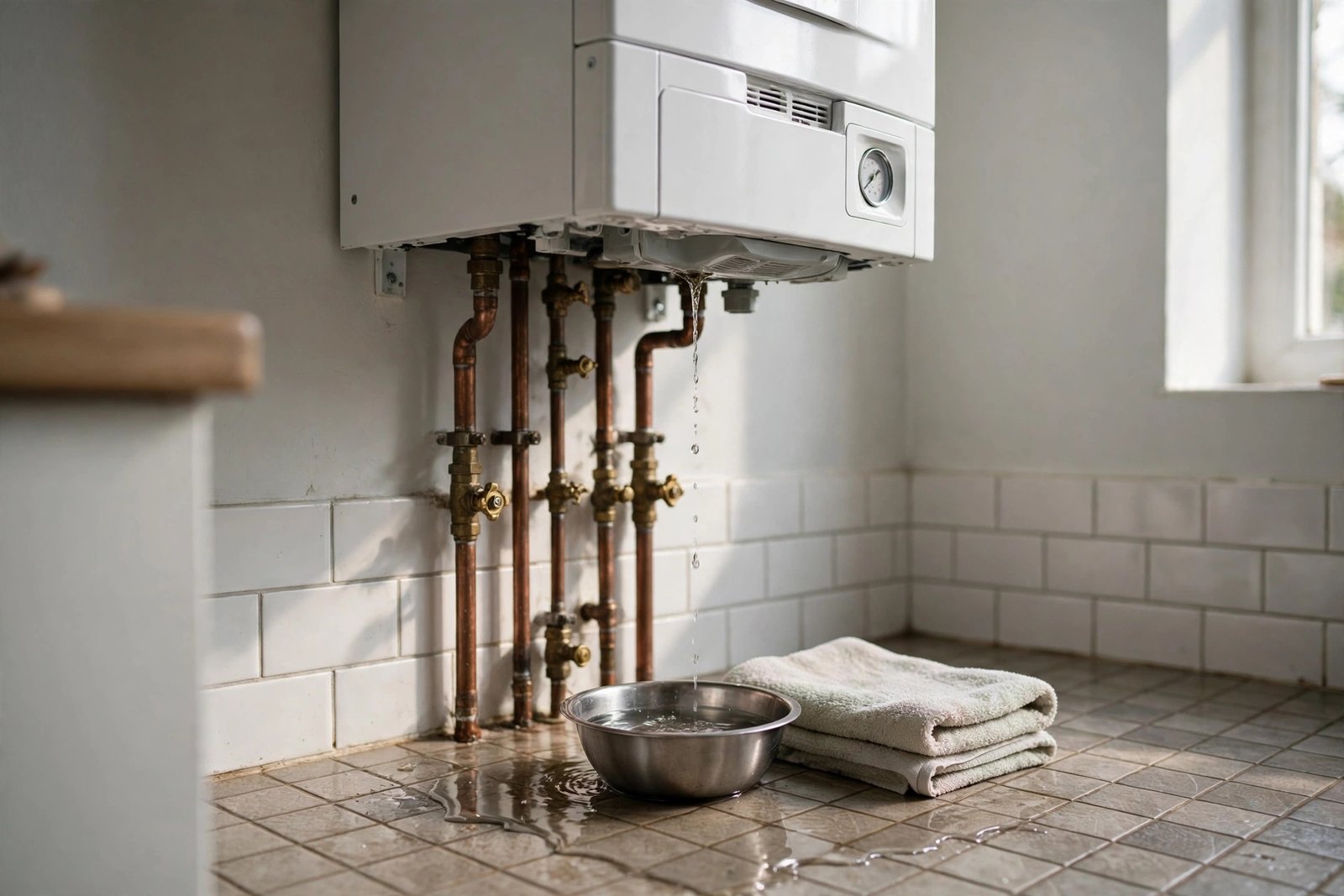
Quick answer: Turn the boiler off, close the cold water valve underneath it, put a bowl under the drip and call a Gas Safe registered engineer the same day. A leak from underneath is usually a worn valve, a loose joint, a failed pump seal or high pressure forcing water out of the relief valve. Never open the boiler casing.
A puddle under the boiler is the one boiler problem you can see clearly, and that is exactly why it is worth slowing down for two minutes before you pick up the phone. Where the water appears tells you what has failed, how urgent it is and roughly what the repair will cost, and it is the first thing the engineer will ask you about. This guide walks you through finding that spot, step by step, then covers what each position means, what it costs to fix in the UK and when a repair stops making sense. Our general guide to a leaking boiler covers the causes in brief; this guide is the diagnostic version, built for the moment you are standing in front of a wet floor.
What Should You Do First If Your Boiler Is Leaking From Underneath?
Work through these steps in order. They are all checks on the outside of the boiler. Never open the boiler casing, never tighten anything inside it and never use leak sealant or tape as a fix. Gas work is for a Gas Safe registered engineer only.
- Smell gas, or has the carbon monoxide alarm sounded? Stop. Leave the property, do not use switches or naked flames, and call the National Gas Emergency Service on 0800 111 999 from outside. A water leak alone does not mean gas is escaping, but a suspected gas emergency needs its own response.
- Is water near switches, sockets or wiring? Do not touch them and do not stand in water to reach them. Switch the power off at the fuse board instead, if you can do it with dry hands.
- Switch the boiler off. Use the switch on the boiler itself or the fused spur on the wall next to it. If the boiler has a plug, switch it off at the socket only if the socket and your hands are dry.
- Turn off the water to the boiler. There is usually a cold water valve on the pipes underneath the boiler, turned a quarter turn with a flat screwdriver so the slot sits across the pipe. If you cannot find it, turn off the water at the stopcock.
- Catch the water. Put a bowl, a baking tray or a folded towel underneath the drip, and move anything that could get wet. If water is coming through the floor, put a bucket under the same spot downstairs.
- Note the pressure gauge reading. The gauge should sit between 1 and 2 bar when the heating is off. Write down what it says, and whether it is climbing, because the engineer will ask. Our guide to correct boiler pressure explains the range and how to top it up safely.
- Call a Gas Safe registered engineer the same day. Even a slow drip can worsen overnight, and water near the boiler electrics is a short circuit risk. Tell them where the water is appearing and what the gauge reads, using the checklist later in this guide.
Where Exactly Is the Water Coming From?
Before you call anyone, spend two minutes finding the exact spot. Dry the floor and the pipes under the boiler with kitchen roll, then watch for a few minutes. The first place to turn wet is your answer. Take a photograph of it, because it is the clearest thing you can show the engineer and it helps if you are reporting the leak to a landlord. The table below covers the four positions water comes from underneath a boiler, and what each one usually means.
| Where you see the water | What it usually means | How urgent it is |
|---|---|---|
| A drip from a joint or valve you can see under the boiler | A loose fitting, a worn washer or a corroded valve under the boiler | Book an engineer, usually a quick repair. Do not overtighten the joint yourself, because a cracked olive turns a drip into a spray. |
| Water running from the bottom edge of the casing, or rust streaks on the casing | An internal part: a pump seal, a pipe joint or, in the worst case, the heat exchanger | Engineer only, and switch the boiler off. Nothing inside the casing is a job for a homeowner. |
| Water from the small copper pipe outside the house | The pressure relief valve is discharging because the pressure is too high | Check the gauge. If it is above 2 bar, the system is overpressurised. Bleeding a radiator can bring it down, but if it keeps climbing, call an engineer. |
| Water from the white plastic condensate pipe | A blocked or frozen condensate pipe, so the water backs up and spills from the boiler | In a cold snap this is the most likely reason. Pour warm water, never boiling, along the outside section until it runs, then reset the boiler. |
Two more clues narrow it down further. If the leak only appears when the heating is on, the fault is on the heating side of the system, and pressure is the first suspect, because water expands as it heats and the pressure climbs with it. If it only appears when you run a hot tap, the fault is on the hot water side, which points the engineer at a different set of parts. Tell the engineer which one it is when you call, because it saves a diagnostic visit turning into two.
What Causes a Boiler to Leak From Underneath?
A puddle underneath the boiler does not say which part has failed, and the cause decides whether there is anything safe you can do or whether it is an engineer job from the start. These are the causes, in the order an engineer would check them.
Pressure too high. When system pressure rises above the safe range, the pressure relief valve opens on purpose to protect the system, and the water comes out through the small copper pipe outside. The gauge should sit between 1 and 2 bar, and the relief valve may start letting water out at around 3 bar. A filling loop tap left slightly open will keep refilling the system and pushing the pressure up, so check that it is fully closed. If the pressure keeps climbing after you have bled a radiator and brought it back to the 1 to 1.5 bar range, the expansion vessel or the relief valve itself may have failed, and both need an engineer.
A worn pump seal. The pump moves water around the system, and the seal around it wears over years of use until it starts to weep. You will see a slow, steady drip from inside the bottom of the casing, often with the pressure gauge falling a little at a time. A seal alone can sometimes be replaced, but on an older pump a full pump replacement is usually more cost effective, and that is a decision for the engineer on site.
Corroded pipes or a corroded heat exchanger. Oxygen in the water reacts with the metal of the pipes over years, and the structure weakens until it starts to leak. This is the most likely cause on a boiler over ten years old, and it is the most serious one, because corrosion in one place usually means corrosion elsewhere too. A single corroded pipe or valve can be replaced, but widespread corrosion, or a corroded heat exchanger, is often the point where replacement starts to make more sense than repair.
Loose joints and fittings. Repeated heating and cooling cycles make fittings expand and contract slightly over time, and a joint under the boiler gradually loosens. You will see a bead forming on a nut or a valve body. This is the most common leak and the least worrying, and it is usually a short repair, but do not try to tighten it yourself. An overtightened compression fitting can crack and turn a drip into a spray.
A blocked or frozen condensate pipe. Modern condensing boilers make a little acidic water as they run and drain it through a white plastic pipe, usually to a drain outside or under the sink. If that pipe is blocked or frozen, water backs up and can spill from the boiler, and many boilers will also show a fault code and refuse to fire. In a cold snap this is the first thing to check, and it is the one cause you can fix yourself with warm water on the outside section of the pipe.
A weeping automatic air vent. The small vent on top of the boiler or the system lets trapped air out, and when its seal wears it starts to weep water down the side of the boiler and onto the floor below. It looks like a leak from underneath, but the water is running down from above. The vent needs replacing, which is a small job for an engineer.
Age matters here. A boiler that has been serviced every year has its seals, valves and condensate trap checked before they fail, which is one reason the annual service exists. Our guide to how often a boiler should be serviced explains what the visit covers and what it costs by boiler type.
How Much Does It Cost to Fix a Leaking Boiler in the UK?
The cost depends on which part has failed and whether any parts need replacing, which is why finding the leak position first matters. The figures below are UK guide averages from Checkatrade, whose boiler repair cost guide was last updated in October 2026, with the heat exchanger figure from Boiler Central. They are ballpark averages, not quotes, so always get a local tradesperson to quote before agreeing to work.
| Repair | UK guide range | Average |
|---|---|---|
| Typical boiler repair, parts and labour | £120 to £750 | About £300 |
| Emergency boiler repair | £225 to £675 | About £450 |
| Gas engineer hourly rate, plus parts | £50 to £80 per hour | About £65 per hour |
| Gas valve replacement, labour and parts | £180 to £220 | About £200 |
| Heat exchanger replacement, parts and labour | £300 to £500 or more | Over £300 |
| Kettling repair, limescale on the heat exchanger | Not listed separately | About £300 |
| Annual boiler service | £80 to £120 | About £100 |
| New boiler, like-for-like combi swap, supplied and fitted | £2,500 to £4,000 | About £3,000 to £4,000 |
A worked example shows how the numbers add up. Take the average gas engineer rate of about £65 an hour. A one-hour visit to replace a worn valve, with a part costing about £50, comes to roughly £115 before VAT, plus any callout fee. That is the article’s own arithmetic from the sourced rates above, not a quoted price. The same visit out of hours costs more, because emergency repairs average about £450, and a heat exchanger job starts at £300 and climbs from there. Before you pay for anything, check whether you already have cover in place, because boiler insurance, a warranty, home emergency cover and some service plans may help with the cost, depending on the fault and your policy. That check is covered later in this guide.
Can You Keep Using a Boiler That Is Leaking?
The short answer is no, not until an engineer has looked at it, and never leave a leaking boiler running unattended. A drip that looks minor can be a developing fault, rising pressure, a corroding heat exchanger or a failing seal, that worsens through the night and damages the boiler electrics, the floor and the ceiling below. Use this list to judge how fast you need help.
- Switch it off now and call today: water near sockets, switches or wiring; the pressure gauge climbing towards 3 bar; the leak getting steadily worse; water coming through the ceiling below; a smell of gas or a carbon monoxide alarm sounding.
- Switch it off and call today, but it is not an emergency callout: a slow, steady drip from a visible valve or joint; pressure steady between 1 and 2 bar; heating and hot water still working. Book a same-day or next-day visit, keep the boiler off overnight, and keep a bowl under the drip.
- Safe to check yourself first: a frozen condensate pipe in a cold snap, thawed with warm water as described above. If the boiler fires normally after the thaw and the leak stops, you have found the cause, but mention it at the next service so the pipe can be lagged properly.
- Do not do any of these: do not keep topping the pressure up to hide a leak, because the water is still leaving the system somewhere; do not use leak sealant or tape inside the system; do not reset the boiler again and again if it keeps locking out. Repeated faults are a sign the boiler needs attention, not another reset, and our guide to boiler fault codes explains the common codes and what they mean.
Should You Repair the Boiler or Replace It?
Most leaks are worth repairing. A loose joint, a worn valve or a failed pump seal is a straightforward job, and a repair averaging about £300 is far cheaper than a replacement. But there is a point where another repair stops making sense, and the signs below are the ones Checkatrade lists for considering a replacement instead.
| Repair it | Replace it |
|---|---|
| The leak is from a joint, a valve, a seal or the pressure relief valve | The heat exchanger is corroded, or corrosion is widespread through the boiler |
| The boiler is under ten years old and has been serviced regularly | The boiler is very old, over 15 years, and parts are hard to source |
| This is the first fault in a year or more | Repairs are becoming frequent, and the bills are adding up |
| The repair costs a few hundred pounds, well below the cost of a new boiler | The repair costs a large share of a replacement, which runs £2,500 to £4,000 for a like-for-like combi swap |
| The boiler still heats the house well and the bills are steady | Efficiency is poor and the heating bills keep rising |
| The boiler is still under warranty, so the repair may be covered | The warranty has expired and every repair is now out of pocket |
A well-maintained gas boiler should last 10 to 15 years, according to Baxi, and a well-maintained oil boiler 15 to 20 years. If your boiler is near the end of that life and the engineer is quoting for a heat exchanger, ask them directly whether the repair will last or whether you are paying to keep an old boiler going for one more winter. A good engineer will answer that honestly, and the quote should set out the diagnostic fee, labour, parts, VAT, whether the repair is guaranteed and what is not included.
What Should You Tell the Engineer When You Call?
Engineers book jobs by urgency, and the details you give decide whether you get a same-day slot and whether they bring the right part. Have this list ready before you call.
- Where the water is appearing: under the boiler from a visible joint, from the bottom edge of the casing, from the copper pipe outside, or from the white plastic condensate pipe.
- When it started, and whether it is constant or only when the heating is on or when you run a hot tap.
- What the pressure gauge reads, and whether it is rising, falling or steady.
- The boiler make, model and age, and any fault code on the display.
- Whether you have switched the boiler off and closed the water valve, and whether there is water near any electrics.
- A photograph of the leak and the gauge, sent by message or email if the engineer asks for one.
- Ask three questions: what is included in the price, will you get a written record of the repair, and is the repair guaranteed.
Book with a registered engineer and check the registration before they start work. For a gas boiler, the engineer must be on the Gas Safe Register, and you can check them on the Gas Safe Register website or by calling 0800 408 5500. Ask to see the engineer’s Gas Safe ID card when they arrive, and check the back of the card, because it lists the categories of gas work they are qualified to do. For an oil boiler the engineer must be OFTEC registered.
Who Pays for the Repair If You Rent Your Home?
If you rent, the repair is your landlord’s responsibility, not yours. Under Section 11 of the Landlord and Tenant Act 1985, a landlord must keep the installations for space heating and water heating, including the boiler, radiators and pipework, in repair and proper working order. No clause in a tenancy agreement can transfer that duty to the tenant. The Homes (Fitness for Human Habitation) Act 2018 adds a further duty to keep the property fit to live in throughout the tenancy.
The landlord’s duty starts once they know about the problem, so report it properly. Report the leak in writing, by email or through the agent’s online system, and keep a copy. Describe what is wrong, say where the water is, note when you first saw it, and attach photographs. If you already reported it by phone, follow it up in writing so there is no dispute about the date. A serious leak, or no heating in winter, counts as urgent, and the landlord should act within hours to a day or two. A slow drip that is not flooding anything is urgent rather than an emergency, and should be dealt with in days rather than weeks.
Do not try to repair the boiler yourself, and do not hire your own engineer without the landlord’s agreement, because the cost may fall on you. If the landlord does not act, ask the council for a property inspection, because a serious leak or no heating can be a Category 1 hazard under the Housing Health and Safety Rating System. The landlord also has a separate annual duty to have the gas appliances checked, which our guide to the gas safety certificate covers in full.
Will Home Insurance or Boiler Cover Pay for the Repair?
Check this before you pay for anything, because many households already have cover and do not realise it. Boiler insurance typically costs £8 to £30 a month, averaging about £15, according to Checkatrade, and some service plans include the annual service as well. A manufacturer warranty may cover the repair if the boiler is still within its term, but most warranties make an annual service a condition, so a missed service can void the cover. Home emergency cover, sometimes bundled with home insurance or a bank account, may pay for an emergency callout. Whether the failed part itself is covered, or only the damage the water caused, depends on the wording of your policy, so read it or ask the insurer directly rather than assuming either way. If you have no cover, a one-off repair averaging about £300 is still far cheaper than a new boiler, and a £100 annual service is the cheapest way to avoid paying it again.
Frequently Asked Questions
Is a boiler leaking from underneath an emergency?
It is urgent, and it becomes an emergency if water is near electrics, the pressure is climbing towards 3 bar, the leak is getting worse, or you smell gas. Switch the boiler off, catch the drip and call a Gas Safe registered engineer the same day, even if the leak looks small.
Can I use leak sealant on a leaking boiler?
No. Leak sealant and tape are not a fix for a boiler, and they can block parts of the system and hide the real fault. The cause has to be found and the failed part repaired or replaced by a Gas Safe registered engineer.
Why is my boiler leaking only when the heating is on?
Because water expands as it heats, so the pressure rises when the heating runs. If the expansion vessel has failed or the system is overfilled, the pressure relief valve opens and water comes out. Check the gauge when the heating is running and when it is off, and tell the engineer both readings.
How do I know if the leak is the pressure relief valve?
Look for water dripping from the small copper pipe outside the house, and check the gauge. If the gauge reads above 2 bar and water is coming from that outside pipe, the relief valve is discharging because the pressure is too high.
My boiler is leaking and losing pressure. What does that mean?
It means water is leaving the system through the leak, so the pressure falls. Topping the pressure up only masks the problem, because the water keeps escaping. The leak has to be found and fixed, and if you are topping up every few days there is almost certainly a leak or a fault with the expansion vessel.
Who do I call for a leaking boiler, a plumber or a heating engineer?
Call a Gas Safe registered engineer for a gas boiler, and an OFTEC registered engineer for an oil boiler. A general plumber can fix a leaking pipe joint under the boiler, but anything involving the boiler itself, including opening the casing, must be done by a registered engineer.
The short version is simple. Find where the water is coming from first, because that one fact tells you the cause, the cost and the urgency. Switch the boiler off, close the water valve, catch the drip and call a Gas Safe registered engineer the same day. Most leaks are a quick repair at a few hundred pounds, and the ones that are not are the ones worth knowing about before the engineer arrives, so you can ask the right questions and decide, with the facts in front of you, whether to repair or replace.